
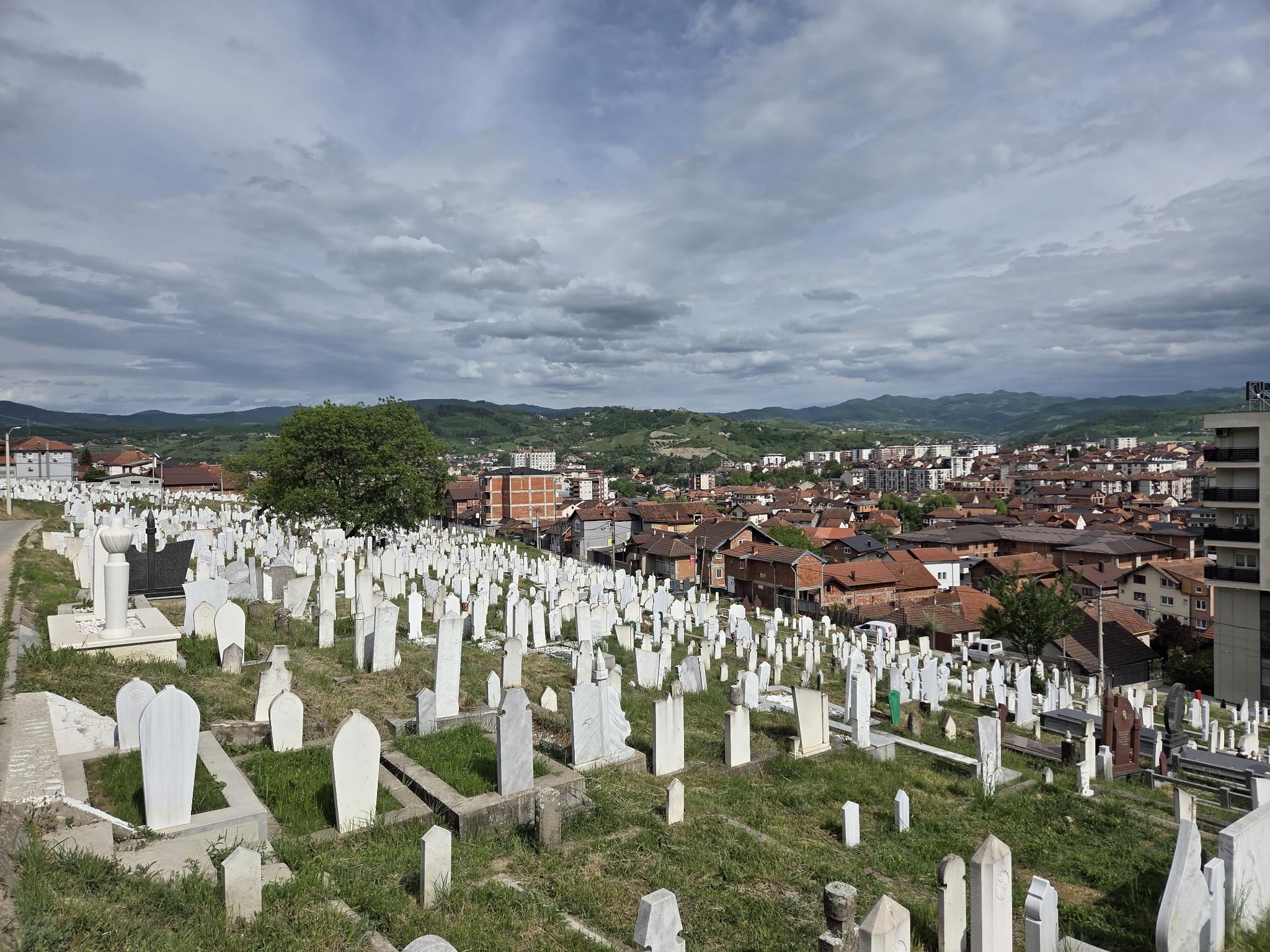
Dobro došli u Novi Pazar! Welcome in Novi Pazar, the unofficial capital of the Sandžak! A city with some quite unique characteristics and architecture I’ve had never seen before. Join me on a tour of impressions through this chaotic city with its giant cemetery and aromatic coffee roasteries!
What is Novi Pazar?
So, let’s start with the dry facts. Novi Pazar is the biggest city in the Sandžak, located in the (south)east of the region and in the southwest of Serbia, not far from the border with Montenegro and Kosovo. It has a population of 70 000 people in the city itself, and around 105 000 in the broader municipality. The city was founded in the 15th century under Ottoman rule and literally means New Marketplace (in contrast to the Old Marketplace about which I will tell in my next post) or Yeni Pazar in Turkish. It is located in a valley, created by four rivers: the Jošanica, Deževska, Ljudska and (famous) Raška. The city is surrounded by green mountains, with the Pešter Plateau to the west (but more on that too later) and is famous for its textile industry and thermal baths. But before this post becomes a Wikipedia page, let’s share some of my impressions of the city …
A chaotic city
Since I myself am not immune to the influence of influencers, I decided to do what a lot of Youtube vloggers do when they are in an unknown city: just jump in a taxi and ask the driver to give you a tour of their city. Mind you, I still think this can be a good idea, but on two conditions: 1) the driver has to actually know something about his city and 2) there must not be too much traffic in the city, so that you can actually move. Unfortunately, these two conditions weren’t met when I took a tour. During my tour I saw the oldest mosque of the city (but only it wasn’t) and the oldest church of Serbia (it was), learned that there used to be more snow in the winter and that my driver had good and bad days during his military service in Slovenia. Most of the tour though, we sat in the car, waiting for the traffic to move.

This brings me to my first impression of Novi Pazar: it’s surprisingly chaotic for what is actually a relatively small city. When I arrived in Novi Pazar after a wild and exhausting bus ride from Prijepolje (only 120 km, but it took us more than 3,5 hours) I wasn’t ready for all the honking and slow-moving traffic in the main street (called Stevana Nemanje), although you still have to be quite careful when crossing the road. Luckily, there is a pedestrian zone in the center, but there you have a surprising amount of small electric vehicles (steps and scooters). It’s probably not the most special characteristic, but it’s something that struck me.
Chaotic in this post also has a slightly different meaning: it’s unfinished, run-down or just a bit rough around the edges. Not that it’s a dangerous city (it’s not), but it’s just not the most ‘refined’ city. Take the houses for example: a lot of them aren’t really finished. It’s not something unique for Novi Pazar though: you see it all around the Balkan and I looked online for an explanation (I didn’t dare to just ask a homeowner why his house was unfinished): it mainly seems a consequence of a culture of ‘self-financing’, people don’t get a loan to build a house, but finance it with their own money. When there is no more money, they pause the construction until they have budget again, thus making the construction of houses last a lot longer than elsewhere (this article explains the phenomenon for Montenegro). It doesn’t necessarily mean that the houses aren’t inhabited, often they are, but with exposed brick walls, unpainted and unplastered, and sometimes a building even has a finished ground floor with an unfinished first floor (probably added on later).

Run-down is a better word when we speak about the public infrastructure: it was once finished, but now it’s a little bit … crumbling. Take the bus station for example: for the main transport hub it is in a surprisingly bad shape. A circular building awaits you, with a seemingly inaccessible ticket office (just buy your ticket on the bus), lots of graffiti and small broken tiles with weeds growing between them. Digital information screens, you say? No, just look on the analogue (paper) timetable. The buses themselves come in different shapes and colours, mine being an old German one where you could still einsteigen and aussteigen (to get on and off ). Those are things I saw earlier in Kyrgyzstan and Uzbekistan (although maybe not even that bad), but I didn’t expect them in Serbia, a much richer country. It pains me to say that I sometimes had the impression of being in an underdeveloped country.


In my previous post I launched the theory that in the Sandžak only religious buildings were (consequently) in a good shape. But then came the Roman-Catholic church in Prijepolje, which was in a terrible shape. In Novi Pazar I decided to take a look at the Jewish cemetery, not expecting much (with the church in mind). It turned out to be more of a grass field rather than a cemetery. As in: the grass was so high that you couldn’t see many of the gravestones. The cemetery is “under special protection” but I’m not sure what this means in Serbia, since I saw signs like these at the most dilapidated buildings. So, it seems I have to adjust my theory a bit: only religious buildings with a living community (Orthodox or Islamic) behind them consequently seem to be in a good shape in the Sandžak.

A Bosniak city
When I speak about a Bosniak city, this has a religious and an ethnical aspect. Let’s start with religion. In contrast to Prijepolje, in Novi Pazar the majority of the people (around 80%) is Islamic. This is something that you notice immediately when coming from another (non-Muslim-majority) city. The first and most obvious sign is clothing. In Novi Pazar you see a lot of women with head scarves (or hijabs) and even women wearing a niqab (a garment covering the entire body and face) aren’t that exceptional. For me this was somewhat unexpected: having been in cities like Sarajevo (with also around 80% Muslims), I knew I would see more people with head scarves then in Prijepolje. Still I have the impression that in Sarajevo the only people wearing niqabs are tourists from the Middle East, while in Novi Pazar it’s mostly local women wearing a niqab (also because when I was there in May 2026, it seemed like there weren’t much tourists). But don’t get me wrong: the majority of people are still wearing ‘western’ (without wanting to sound too stereotypical) clothing and it’s very common to see ‘mixed’ groups (with people wearing both Islamic and ‘western’ clothing). So based on these – completely unscientific – observations I would say they practice a quite moderate Islam in the Sandžak.
Secondly, let’s talk about architecture. Novi Pazar has some quite special buildings that I had never seen before. I would describe the architecture in the city as a mix of communist brutalism with eastern or Islamic styles. A good example of this is the Hotel Vrbak in the city center. Built over the river Raška in the mid-seventies it is one of the landmarks of the city. You can see the oriental (or Islamic) influences in its dome, the arch windows and small circular ‘extensions’ around the rhomboid structure of the hotel. SInce I’m not an architect expert though, I will let the pictures speak for them. Suffice it to say that the hotel isn’t the only example of this architecture in Novi Pazar (see the end of the gallery).


Going from the religious towards the ethnical aspect. I would say another sign of the Bosniak nature of Novi Pazar, is the sense of a certain connection with the Palestinians. It is something you can recognize in graffiti, flags and (quite beautiful) murals and is also visible elsewhere in the Sandžak (and in Bosnia). If you think about it, it’s also quite logical: not only do they share the same faith with the Palestinians, I can imagine that the current situation of the Palestinians brings back quite painful memories from the nineties for many Bosniak people.

Last but not least, let’s talk about the Bosniak identity. This identity is quite present in Novi Pazar and is emphasized in different ways: you see it in the Bosniak flags, in murals, in the offices of the different parties representing the Bosniak minority in Serbia and in the graffiti calling for the autonomy of the Sandžak. Although I never had the impression of travelling through a militant separatist region. As I said in my introduction: the political parties are pretty much incorporated in the Serbian political system and people seem to be quite aware that independence or unification aren’t very realistic options. I would say that the Bosniak identity is certainly present and emphasized, but without a real(istic) striving towards political autonomy or independence.


A football-loving city
Imagine going to Paris to visit the Eiffel Tower, to see that it is covered with a giant banner calling you to go to the next game of the football club PSG. Wouldn’t that be odd? It is (with a bit of exaggeration) what they do in Novi Pazar. When I was there the 15th-century fortress of the city (under renovation) was decorated with a banner saying “Svi na Marakanu” meaning “Everyone to Marakana”, Marakana being the stadium of Red Star Belgrade, the most succesfull football club in Serbia. On the ninth of May 2026, the team of Novi Pazar played against Red Star in Belgrade and won. I wasn’t there at that time but I can imagine they were pretty happy in Novi Pazar.
Football thus is quite present when strolling through the streets of Novi Pazar. Especially if you stroll along the banks of the Raška, which are decorated with murals from the supporter groups of FK Novi Pazar, some of which have quite a ‘colourful’ reputation. So if you want the real Novi Pazar experience: go to the stadium (it’s located quite close to the center) on matchday and enjoy the game, but I’m not responsible for any hearing damage.


An Ottoman city
The last aspect of Novi Pazar I would like to talk about is the fact that it is an Ottoman city. As I said earlier, it was founded in the 15th century by the Ottomans and that’s something that is still visible today. Mainly in the city center where you find some elements that are typical for former Ottoman cities. The sebilj for example, a wooden fountain where you can get free water, although the one in Novi Pazar is a replica from the one in Sarajevo.

Just as in Sarajevo, Novi Pazar also has an old town, in which you can stroll between the typical Ottoman houses with small shops in them. In one of these, you can find the Amir-agha inn, a charming inn from the 17th century which used to be part of the bazaar. Next to the inn we smell the pleasant aromas of the coffee roasteries that are also common in the center. By the way, I would certainly recommend to drink a Bosnian (unfiltered) coffee in one of the coffee houses. Making it involves a whole ritual about which you can read more here. It’s a tasteful (and cheap) drink that comes with some lokum (Turkish delight, a kind of sweets) and automatically makes you relax.

Unfortunately, not all the Ottoman heritage is in a good shape. The prime example of this being the Isa-Bey’s hammam, one of the oldest monuments of Novi Pazar built in the second half of the 15th century. It was a public bath house with identical rooms for men and women featuring 11 domes and a fountain. It is protected and was declared a national monument in 1983, but is largely inaccessible and in a terrible state. When I asked the waiter of the nearby coffee house if there where plans to renovate it, he answered that there have been plans for 10 years, but nothing ever happens and that it’s all lies. Honestly, it’s quite shameful how Serbia treats its monuments. If you want to see it though, go drink a coffee in the garden of the coffee house next to the hammam and ask the waiter if you can take a look inside.


The Ottoman Empire has been gone for over a century. What has remained of it, is its heritage, but maybe also its influence. By this I mean, if you walk around in Novi Pazar, Prijepolje or Rožaje there is a subtle thing that you will see a lot: signs that say that this or that (government or religious) building was financed by the European Union or some Middle Eastern country, but most of all by TIKA, the Turkish Cooperation and Coordination Agency, the USAID of Turkey so to say. It is quite remarkable how present they are in the region and if you ask me, they’re not just doing it for the buildings.
Novi Pazar is …
So what is Novi Pazar? I would say it’s a quite unique mix of the above-mentioned aspects. Would I recommend a visit to the city? Not if you’re looking for a refined, aesthetically pleasing and calm destination. But if you like it a bit differently and want to see some architecture that you’ve never seen before whilst enjoying a cheap coffee, then just give it a try!