
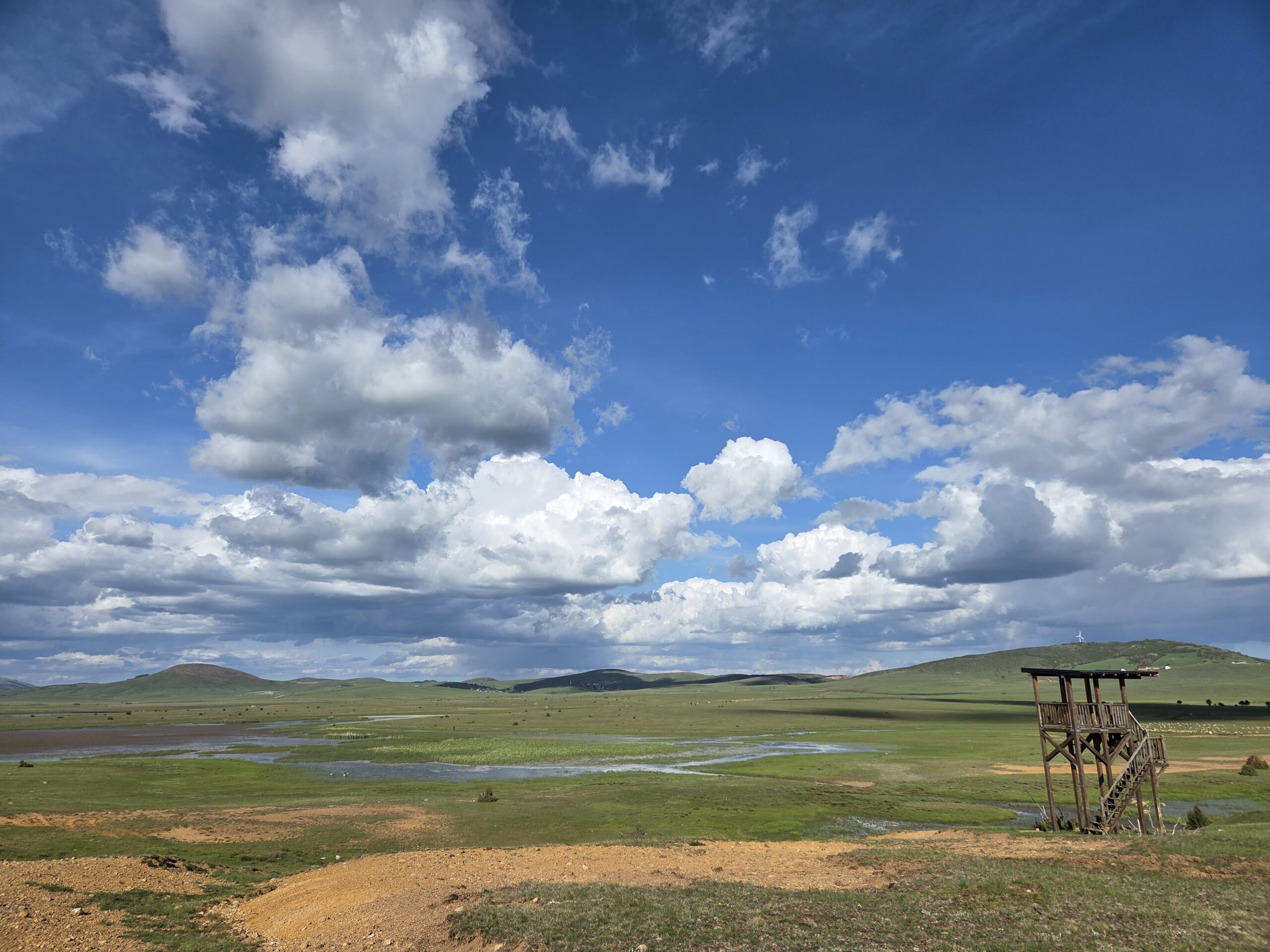
Imagine seeing herds of sheeps, cows and even goats in a vast landscape. Some scattered villages with minarets, shiny domes and small houses. Meanwhile a car drives on a lonely road towards the horizon (or the next village)… That is where we’re going in this post: the Pešter Plateau.
Before I start this post, I probably owe you an apology. The title of this post is quite misleading: firstly, yes, I spent a night on the coldest place of Serbia, but not at a moment that it was particulary cold and, secondly, in this post I will actually talk more about the days before and after the night than about the night itself. With this pure clickbait behind us, let’s start this story.
UNESCO heritage in different forms
After visiting Novi Pazar, I leave the city in an old German bus (see my previous post) with my first stop being the monastery of Sopoćani. To get there we have to drive out of busy Novi Pazar, through the suburbs into the forested hills that surround the city. After 30 minutes or so the bus stops at the monastery and I get off. The monastery of Sopoćani dates back to the 13th century and was an endowment of Stefan Uroš I, one of the first (and also most important) kings of medieval Serbia, with the intention of being his burial church. Starting from the 16th centruy the monks had to leave several times due to the Ottoman threat, and eventually leaving definitively at the end of the 17th century. The monastery was then deserted up until the 20th century. Eventually the delapidated church would be restored, but not the surrounding buildings (of which you can still see the ruins). The monastery was declared a World Heritage Site in 1979 and is still in use (with some new buildings outside the old walls).

At the entrance there is a sign that foreign visitors have to pay a 5 euro entrance fee, but since there is no one controlling it and since I’m practically a Serbian with my language skills (😉), I decide not to pay the fee. Some church-goers are sitting outside on benches underneath a canopy, talking and enjoying a drink. A few girls walk around, dressed in identical skirts. I ask them if today is a special day an it turns out te be another slava, the annual ‘feast’ of the monastery. Although this time it seems to be without procession and giant icon, in contrast to the one in Prijepolje. The monastery itself is well-kept (as always) and gives you nice views across the valley. The church has some really nice frescoes, although somewhat damaged (which is logical considering the two centuries of abandonment). The frescoes were influenced by Byzantine art and are among the most beautiful in Serbia. Since taking pictures wasn’t allowed, I will only show a few (illegal) pictures here. All in all it’s a very pleasant experience, both the monastery itself as its surroundings, although you won’t walk around for hours.


On the other side of the road, you can go to the source of the river Raška, but be aware that this includes walking (or rather sliding) down a quite steep trail after which you arrive at a small water reservoir that you have to cross (you can walk on the concrete edge) in order to climb some steps up to the cave out of which the water flows (or rather gushes). It’s a very pleasant setting, but unfortunately the trash lying everywhere around you quite ruins it. It’s a painful conclusion that a lot of the people in the Sandžak don’t seem to care much about their trash (just drive on any random road and you’ll see what I mean).
Maybe you wonder: why would I want to see the source of an unkown (and only 60-km long) river in Serbia? Good question, fact is that this river gave its name to the region of Raška, which is today an oblast (a district) in Serbia but was historically deeply connected with the Serbian medieval state. Small history lesson: at the end of the 11th century the Grand Principality of Serbia emerged and soon also included the Raška region, which became the center of the principality, with the city of Ras being its capital. The principality eventually became a kingdom in the 13th century with the name Raška or Rascia becoming a synonym for this state. As such, you would expect the source of the river that gave its name to this all to be a popular destination for the (fairly nationalistic) Serbians. Based on my experience (I was completely alone and it was not very accessible) I would say that that assumption was wrong.


After the source of the Raška I decided to stay in theme and visit the nearby remnants of Stari Ras (or Old Ras), as said, the former capital of medieval Serbia. Together with Sopoćani it forms one World Heritage Site. To get from one to another you can just follow the asphalt road or go through the forests (at your own risk, I did this but the path isn’t always that visible), it’s only 5 km. Stari Ras is located on a hill, which is logical considering it served as a frontier fortress in the Roman Empire (before becoming the capital of the Serbian kingdom). As such it still offers beautiful views on Novi Pazar. The fortress itself is in quite a good shape and you can clearly see the outline of the city and some remnants of its buildings. Unfortunately, the facilities are somewhat limited: I found exactly one information panel with some very limited explanation, the entrance of the site is quite ‘subtle’ and the path down the hill towards the usual starting point for a visit of Stari Ras is in a bad shape and I almost fell a few times while descending. Ironically, the tourist village at the foot the hill where you start your visit is in an excellent shape. Serbia and its heritage (even World Heritage): it doesn’t seem the best combination.


The Pešter Plateau
Once descended, I’m ready for the main goal of this trip: the Pešter Plateau, the largest field of Serbia (50 km²), located to the southwest of Novi Pazar at an altitude between 1000 to 1500 metres. It is also known as the ‘Siberia of the Sandžak’ for its harsh winters and is only sparsely populated. I order a taxi and whilst waiting I take a look at the remnants of Staro Trgovište or Old Marketplace (in contrast to the New Marketplace or Novi Pazar), an important trading center during the Middle Ages that was connected with the fortress of Stari Ras, but would end up abandoned.
The Pešter Plateau (or Peštersko Polje) doesn’t come unexpected: while driving, you see how the landscape changes, the forested hills are replaced by a wider landscape of lower grass hills. Finally you cross the last ridge and the majestic plateau unfolds itself before your eyes. You see herds of sheep and cows and it feels odd to be in such a vast landscape after all the hills and hairpin turns. The taxi driver drops me of at the gas station of Karajukića Bunari, a village in the middle of the plateau and I walk towards the Kamp Peštersko Polje, my place for the night.

The camp has a bit of a ‘wild-west’ vibe and is hosted by a lovely couple that changed busy Novi Pazar for the silence of the plateau and offers some small bungalows, homemade food and horse rides. It’s all quite basic (don’t expect a hot shower) but the views, the food and the quietness more then make up for it. After I’ve installed myself I go for a walk to the Peštersko Jezero (or the Lake of Pešter). It’s a pleasant environment and the herds with their shepherds remember me of long-gone times (without becoming too romantic). The plateau is slightly rolling but that doesn’t impede the view. Although most of the land seems to be used for cattle breeding, there is some arable land too. The lake itself is quite shallow and I wouldn’t be surprised if it varies greatly in surface, depending on the rainfall. Apparently there are fish living in it, since a few men are fishing. The surrounding terrain is marked as swamp on the map, although the cracks in the ground indicate that the soil is rather dry at the moment.

After some contemplation near the lake I walk back to Karajukića Bunari and walk around the village. It’s a small village (only a hundred people) but still offers a mosque (with a live view of grazing cows), a post office, a school, a gas station, an office of a political party (or at least a sign that says so), a fastfood place and a small restaurant. The wooden houses are quite low and the barns and cattle in their gardens indicate the main profession of the villagers. It is here that the lowest temperature ever in Serbia was recorded: -39,6° C. The cold temperatures are made possible because of so-called ‘lakes’ of cold air: when the ground is covered in snow and the night is clear and without wind, cold air from the mountains around the plateau descends and creates these lakes. Luckily, today it’s a bit warmer but I still decide to enter the small restaurant for a Bosnian coffee. The owner seems a bit grumpy and asks if I don’t want to eat anything. I just order some bread (knowing i will have diner later in the camp), but eventually he comes out of the kitchen with domaći sir (homemade cheese), ćevapi (small sausages) and an unknown vegetable (and bread of course). I don’t refuse and eat it with great relish. When I ask the bill, he answers me that I don’t have to pay, that it’s his treat. Walking back to the camp, I realize that this seems to be a typical example of Slavic friendliness: at first a person can seem grumpy or even unfriendly, but in the end they will help you the best they can and give you a warm welcome, without expecting much in return. It’s a sincere attitude that I quite like.
Before I go to sleep, I want to give some attention to cycling. I went to the plateau by taxi, but some local organisations in the Sandžak have started to promote cycling on the plateau, an activity I think is very suitable for this place. Check out their site here, if you’re interested.


A hitchhiker’s guide to Montenegro
After a windy night in the camp I eat breakfast and get ready to leave. I pay (only 37 euros for 2 meals and a bungalow) and chat a bit with the owners before walking to the main road where a taxi driver would come to pick me up. Would come, because he never arrived. It seemed that some misunderstanding had left him with the impression that I didn’t need a ride anymore. So, hitchhiking it is, luckily the second car that passes already stops. Today I have to get to Ribariće, where I’ll take a bus to Rožaje, the starting point of the Montenegrin part of my journey (you can see my route here).

The driver, a friendly local, drops me off in the small village of Suvi Do where he says a bus will arrive around noon. I can’t find anything about the bus online, but I decide to trust him: public transport and online time schedules aren’t a good match in the Sandžak. I have some time to kill, but luckily a few school children provide entertainment: it’s nearly noon and the nearby basic school is finished, so all the children are leaving. When they see me, they seem to have the discovery of their life: a foreign guy speaking their language, it’s not usual in Suvi Do. Soon I’m surrounded by kids asking me all sort of questions: “Where are you from?” “Which language do you speak?” “What are you doing here?” When do you come back to Suvi Do?” “Can we have your Instagram?” They also ask me to say “[name of a friend] je budalo” (meaning “he/she is a fool”) in Dutch (my mother tongue). When I say the phrase they find it hilarious that I can insult someone without him or her understanding it. The kids seem to live a happy life and don’t find it boring in small Suvi Do. They don’t speak a word of English though, which I hope isn’t an indication of the quality of Serbian education. Unfortunately, the bus already arrives and I have to shake a lot of hands before I can jump on it.
The taxi driver/philosopher
The bus first takes me back into the hills, away from the plateau and then drives back down, into the valley where we arrive in Tutin, a small town with 11 000 inhabitants. I won’t say much about it here, because I was only there for about half an hour, but it felt a bit like a mini-Novi Pazar. Once arrived I decide to take a taxi to cover the remaining 20 km to Ribariće. Normally finding a taxi is no problem, but just when I really need them the most, they all seem to have their lunch break. So eventually I send a message to the taxi driver from that morning, who didn’t show up in Pešter. Luckily this time he does show up and so we leave Tutin.

The taxi driver turns out to be a nice guy. His name is Mithat, he’s a Bosniak who has worked for 15 years in Germany, so we speak a mix of Serbian and German. He went to Germany in the 90’s, away from the war, although there was no fighting in the Sandžak. The tensions were so high though that people still fled. In Germany he worked in construction but after an accident he couldn’t do the hard work anymore and returned to Serbia where he became a taxi driver. About the Serbs he says that “they did a lot of evil things in Bosnia during the war: killing people, even children and raping women.” Today though the relations between the ethnic groups are okay, he says, although there always remains some tension.
When it comes to the economical situation in the Sandžak, Mithat is mixed: “The economy is good: we have money because a lot of people emigrate and send money to their families here, but what are we with all that money if we don’t have decent schools or hospitals?” It’s a strange reasoning: I wouldn’t say the economy is good if everyone emigrates. Mithat himself gives the example of his uncle whose four children all live abroad, and they are no exception. He also shows signs of so called Yugo-nostalgia, or a certain longing for Yugoslavia, which a lot of people here seem to have. “In Yugoslavia, people didn’t have money but they laughed and chatted with each other, now, we have money, but we have lost our zest for life.” When we talk about the political situation, he says that of course the people in the Sandžak want independence, but the region is divided between three countries (with the third one being Bosnia, I assume), so it’s not very realistical. “The most important thing though – regardless if we are part of Serbia or independent – is that there is peace.” And with this quote we arrive in small Ribariće, where I wait for my bus to Montenegro (who arrives half an hour late) and where this post ends.
