
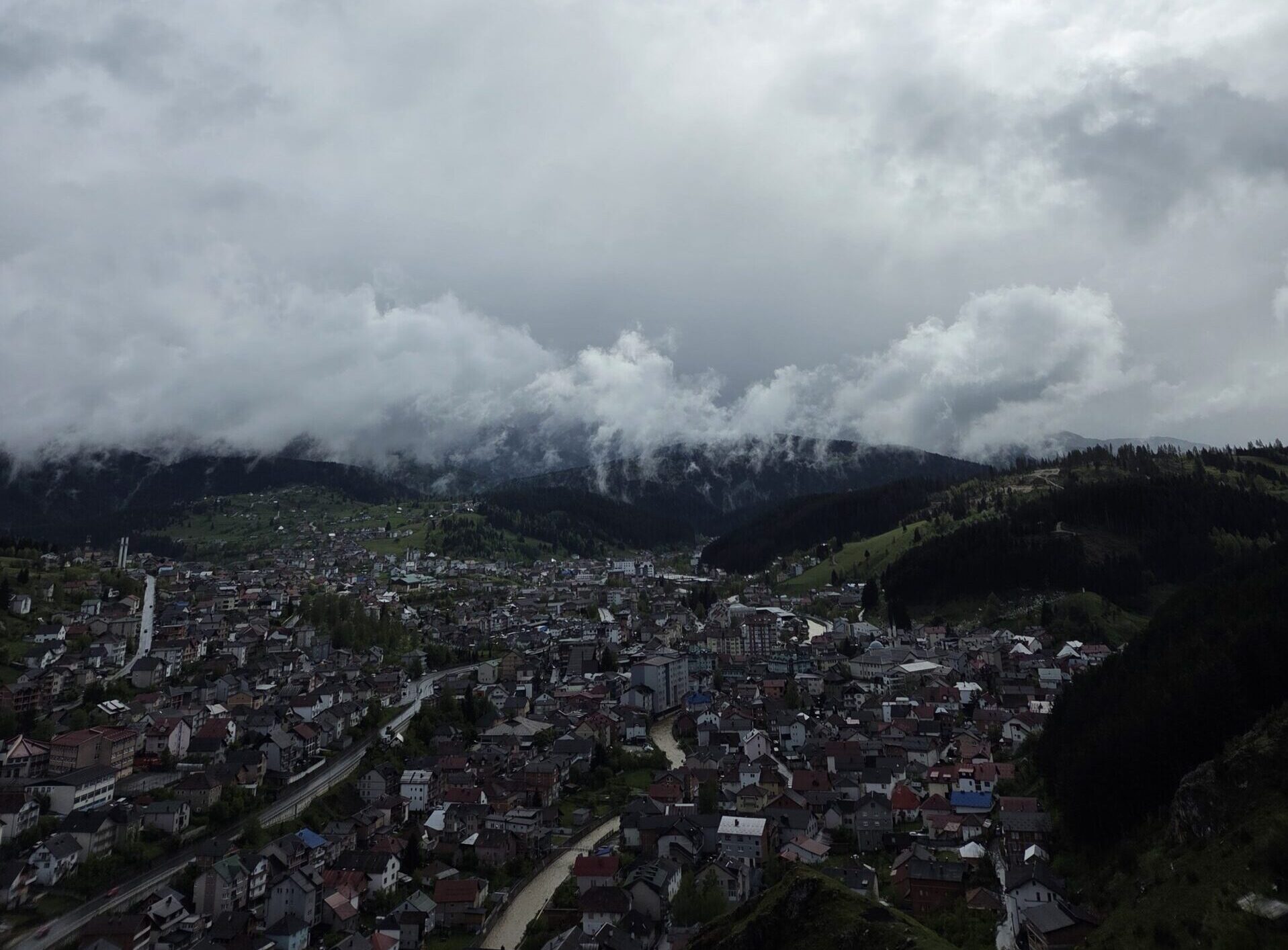
Welcome in the Montenegrin part of the Sandžak! At first sight, not so different from the Serbian Sandžak, but when you look closer you’ll see different dynamics, different landscapes and even … new infrastructure. So it’s more than necessary to spend some attention to this part too.
First of all, I want to stress here that it was not my intention to spend less attention to the Montenegrin part of the Sandžak. Unfortunately this will be the case (I will only write one post about this topic), because I could spend less time in Montenegro than I had hoped. Firstly, because of the delay whilst leaving the Pešter Plateau and secondly because of a lot of rain that kept me inside for the better part of my stay in Rožaje.
Rožaje, the center of the Bosniaks
When you look up Rožaje on Wikipedia, it says that it is the centre of the Bosniak community in Montenegro. And it’s something you notice when entering this town with its 14 000 inhabitants, together with the mountainous look and feel of this place. I arrived in Rožaje on the evening of the matura , the state exam at the end of secundary education which is celebrated with a kind of ‘prom’ ceremony. For this festive education the main street was covered with a red carpet and the boys and girls were dressed in their nicest costumes and dresses. What struck me the most were the flags of the Sandžak (green-blue with lilies and crescents) and Montenegro, brotherly hanging next to each other above the main street. It immediately gives you the impression that the Montenegrin and Bosniak identity aren’t irreconcilable.
The rest of the evening I rest, after my exhausting trip to the Pešter Plateau and only go out to eat something in a charming restaurant owned by a famous Bosniak artist (but more about that in the next post). I walk along the wild Ibar, a mountain river that springs from nearby the mountains and flows towards Central Serbia. The mountains here are higher than in Serbia, over 2000 metres, and you can see their snowy peaks not that far away. Together with the fresh air it creates a charming mountain town, albeit somewhat run-down.

A walk trough this odd-roofed town
The next morning I stay in my hotel for the better part of the day, because it’s raining a lot. The most exciting thing during these hours is a wedding procession during which gunshots are fired (hence the first part of the title). Although forbidden, it’s a tradition that’s still practiced in Montenegro (called šenlučenje), sometimes leading to injuries. It’s only after 3 p.m. that the precipitation somewhat stops and I risk to go outside. On the town square I see a tourist information board which suggests a small hike in and around the city center to discover historical Rožaje. So off I go, fully relying on this information panel.
First stop is the Zavičajni Muzej (or the local museum), located in an old watch tower. These local museums seem to be typical for the Sandžak (I also saw them in Prijepolje, Nova Varoš and Novi Pazar), but don’t expect to discover the new Louvre. In this particular case, the museums features three floors, showing you an array of different objects and pictures of Rožaje, a typical Ottoman room and some traditional clothing. There’s not much in terms of information or a coherent story, but the charm is there. When I visited the museum, I wasn’t sure if it was open, but two guys tidying up said I could visit it, so I walked around for twenty minutes, switched on the lights myself, and left knowing how a telephone in Rožaje looked like a hundred years ago. Still, the visit was free, so I don’t complain.
The next stop is more worth the effort: it’s the Kučanska Džamija, a small mosque in wood and bricks that is more than two centuries old. It’s probably one of the nicest and most charming mosques I’ve ever seen and the fact that you have to duck to go through the door makes it even more authentic. This mosque is actually an example of the typical style of Rožaje. The main characteristic of it being the fact the the roofs of the houses are very steep and four-sided. A lot of these houses disappeared, but you can still see examples of them around the town.

My walk brings me outside the center and into the hills, where the archeological remains of a Roman fortress from the third century (AD) await me. I’m more interested in the views on Rožaje and its neighbouring valleys though, which are quite stunning here, certainly with the cloud formations. The remainder of the hike leads me over some green hills, back into a side valley of the town, where I’d expect Heidi to pop up at any moment. Instead of Heidi though I get to see some traditional houses and the modern (main) mosque of Rožaje. It’s interesting to see how this town had a typical style back in the Ottoman times, that differs quite a bit from the styles a saw in Novi Pazar, Prijepolje and other towns in the region.


Before leaving Rožaje I want to give a small shout-out to palačinke or pancakes. Of course, pancakes exist all around the world in lots of different forms and flavours, but in Serbia and Montenegro (and probably the rest of the Balkan too), they seem to be particularly fond of them. In the Sandžak, pancakes with all kinds of krem (spread) and of course pieces of keks (biscuits or cookies, typically from the brand Plazma) are quite popular. I ate some in a small pancake house in Rožaje (for only 2 euros), but you’ll find them everywhere. Certainly give them a try!
The taxi driver/philosopher (part 2 & 3)
There I was, on a Sunday morning, waiting at the decaying bus station Rožaje for a bus to Bijelo Polje that would never come. Option two it was: a more expensive taxi. Luckily, with the ride you also get a conversation. And in this case I had good conversations. So let me tell you something more about the taxi drivers, because I think who they are and what they do, says a lot about the Sandžak.
The first taxi driver (I don’t know their names unfortunately) is a former police officer who likes to hunt. After he assured himself that I was not an illegal immigrant and possessed the right documents (some refugees travel through this region to enter the European Union), he tells me something interesting about the hotel I stayed in in Rožaje. It is owned by Safet (or Safo) Kalić, the mafia boss of Rožaje. Google his name and you’ll find terms like “narco boss” or “escape king“, but don’t you worry, because my taxi driver (and former police officer) repeatedly assured me that he was a real gospodin (or gentleman), that never killed anybody but only smuggled drugs. He was good friends with the former government of Milo Đukanović, but after a change of government he had to flee to Dubai. Nowadays it’s the family of Kalić that runs the hotel, so says my taxi driver.
After telling me about the mafia boss, the driver stops and takes of the taxi sign from his roof (he can’t pick up clients in another municipality), he drives further and – after 15 minutes or so – decides to put on his seatbelt. Then he starts to show me pictures of his bodybuilder son on his phone and tells me how it’s easy for him to cross the border into Serbia, since he knows the police officers at the border crossing. If this all sounds a bit ambiguous to you, I can assure you, he did ask a fair price for the trip to Berane, a town thirty kilometers to the west of Rožaje (20 euros).
In sleepy Berane I decide to immediately take a second taxi to Bijelo Polje. This time the taxi driver is a pensioner who loves to fish in the Lim, the river we are driving along. He only gets a minimum pension of 450 euros/month and after paying for his utilities he has only a 100 euros left. So he has to work as a taxi driver to earn another 450 euros, but he likes his job and doesn’t mind it. What he doesn’t like is the corruption in Montenegro. He gives me a recent example: a week ago the police of Bijelo Polje did an action in Berane to control if people were wearing their seatbelt and vice versa. Why? To avoid that people won’t pay a fine because they know the police officer, or his brother, mother, father … In Montenegro, he says, family ties are everything. If you belong to or know someone in the right families, everything is possible. Meanwhile, the economy is bad: a lot of people emigrate and the rest moves from the countryside to the city, hoping to find work there, but there isn’t any. It’s a shame, he thinks, because it’s possible to earn lots of money in the countryside, you only have to work hard.
This taxi driver too is a yugo-nostalgic who thinks life was better in Yugoslavia. The different nationalities were living together peacefully. Now you have five nationalities in Montenegro (Montenegrins, Serbians, Bosniaks, Albanians and Croats), but there are tensions, mainly with the Serbians. He himself is an ardent Montenegrin, who hopes for a better future. Maybe the EU will give us that future, although he’s pessimistic: “Every day I put on my television and hope for something positive … but it’s only negative.”
Sunday is rest day in Bijelo Polje
Still thinking about these conversations, I arrive in Bijelo Polje. A town with 13 000 inhabitants in the middle of the Montenegrin Sandžak, located on the banks of the river Lim, the same river as in Prijepolje. Here the population is more mixed compared to overwhelmingly Bosniak-Rožaje: 40% Bosniaks, 25% Serbians and 20% Montenegrins. The difference is visible in the lack of Bosniak flags and graffitis for Bosniak parties. Unfortunately, I can’t tell you much about my visit to Bijelo Polje, because I was there on a Sunday, and they tend to respect their Sunday rest quite well. So shops were closed, streets were quiet and people were sparse.
What I did discover in Bijelo Polje was something I’d barely seen before in the Sandžak: new (public) infrastructure. Being a little bit of a train enthusiast, I decided to go to the railway station of Bijelo Polje, located in an industrial zone at the edge of the town (there’s another smaller station close to the city center called Lješnica). And what a delight it was to see an actual modern, functioning station, clean, accessible for disabled and blind people and with urine inside the toilet, rather than on the floor of the pedestrian tunnel. I don’t know why this station is in such a good shape (maybe because it’s the station where the night train from Belgrade to Bar stops for customs and other formalities), but I would very much recommend the authorities to upgrade the other stations in a similar way.
Walking back along the bank of the Lim I encounter another piece of new infrastructure: a nice waterfront with benches and a playground. After this, I do a small tour through the city center of Bijelo Polje with its Parc of Poets (with the statues of local poets), its mosque and more memorably its small but suprisingly old Orthodox church (the Church of Saint Peter and Paul, built in the 12th century). Also, if you’re there, try to take a look at the fire station: they have some nice retro equipment.


And so, on a Sunday evening in Bijelo Polje whilst eating palačinke, ends my journey through the Sandžak. A hidden gem with stunning nature and lovely people, but visiting it is not always a walk in the park. Luckily, in my last post I will try to make this region a little more accessible with some practical information.