
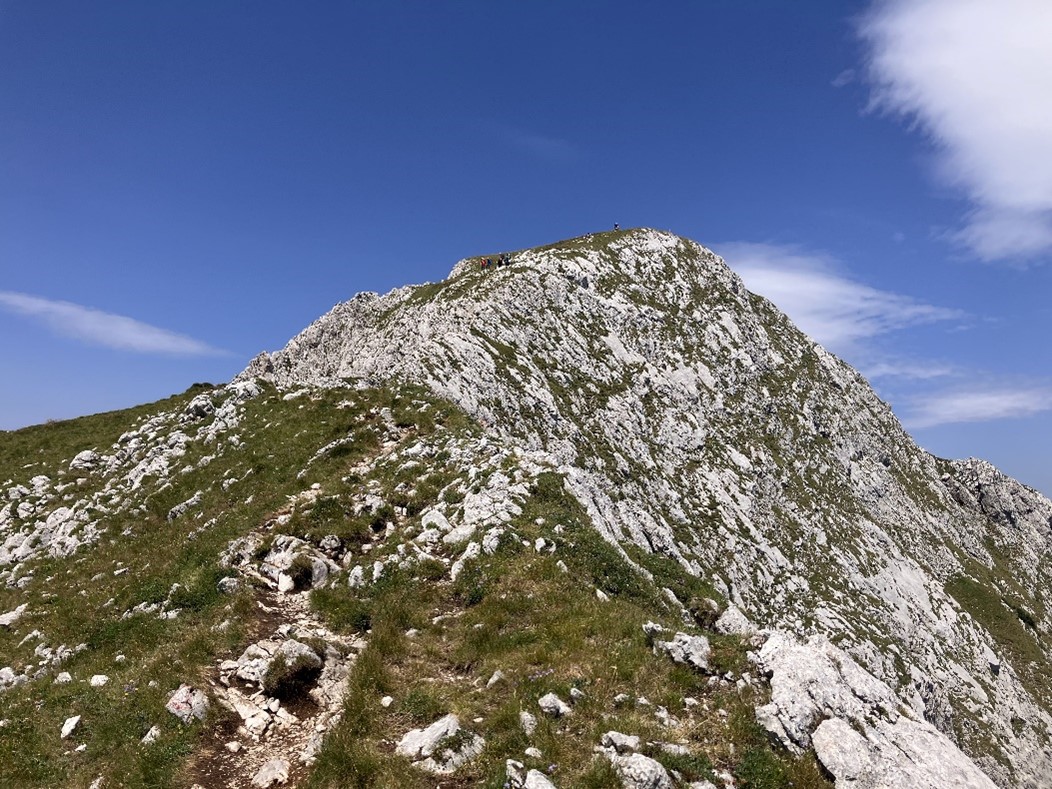
In this post I would like to tell you the story about how I climbed the Maglić, with its 2386 meters the highest mountain of Bosnia and Herzegovina. This is the first episode of my series ‘Balkan’s highest peaks’ in which I try to climb the highest mountain of every Balkan country. I took this adventure on me in the summer of 2024, when I was following a summer course of Bosnian/Croatian/Serbian in Sarajevo, the capital of Bosnia and Herzegovina, which means that I’m writing this from memory, so please, don’t shoot me if I get some details wrong.
Getting to it
My adventure starts on a Friday evening. After my daily course, I hurry myself to the rental agency, where I had reserved a car a few days earlier. After some administrative formalities, it becomes clear that the car I had reserved, isn’t available. But, they assure me not to worry: a guy from another rental agency will come with a car and help me out. Turns out that this other car is a seven-seater Volkswagen minivan. Since I’m only one guy, my 20 liter backpack will enjoy the abundance of space and leg room on the rear seat. I start talking with the new rental guy in Bosnian, but when it comes to the technical explanation about which lights on the dashboard I can ignore, we switch to English. Still, when I’m saying my phone number in Bosnian, he calls me a mali bosanac or a ‘little Bosnian’. Can’t say I’m not flattered by this compliment.
With all the practicalities behind me I can really start my endeavour. First I have to leave Sarajevo, which means entering Istočno Sarajevo (or ‘East Sarajevo’), a new city created after the war mainly populated by Serbians and belonging to the Serbian part of Bosnia (the Republika Srpska). This ‘border-crossing’ is noticeable: no more remembering Srebrenica here, but a sign about the 157 000 Serbians that had to leave Sarajevo at the end of the war and flags of Serbia and the Republika (which is very similar to the Russian flag) everywhere. Luckily, the scenery doesn’t care about ethnic divisions: driving in Bosnia is like driving in a postcard, or rather, driving in a lot of different postcards, since after every corner there is another beautiful view. I’m driving on the M18, a two-lane road which runs along rivers like the Željeznica, the Bistrica and more famously the Drina. This means: passing through gorgeous gorges and valleys surrounded by forests and rocky hills. I’m enjoying the ride but my radio connection not so much: the Balkan music that seems to play on every radio channel comes with a lot of distortion.

A small history of Bosnia and Herzegovina
Writing a history of Bosnia and Herzegovina is a difficult and sensitive task. Since this post is primarily about nature, I won’t explain it all in full detail but rather give a brief abstract that hopefully makes you understand the sensitivities in this country.
Where to start? After World War II the former Kingdom of Yugoslavia became a communist state under the leadership of Josip Broz Tito. It was a multi-ethnic state consisting of 6 republics (Slovenia, Croatia, Bosnia and Herzegovina, Serbia, Montenegro and Macedonia) that was mainly held together by the rule of Tito: ethnic differences weren’t invisible, but were more of a folkloristic thing. This changed after the death of Tito in 1980. The glue that held the state together disappeared and nationalistic tendencies started to spread. At the beginning of the 90’s the different republics of Yugoslavia started to declare their independence. For ethnic quite homogeneous republics like Slovenia, this was a rather straightforward process, but in Bosnia and Herzegovina things where a little different …
Here we had the co-existence of three ethnicities. The catholic Croats, muslim Bosniaks and orthodox Serbians. The Bosniaks and Croats preferred independence, while the Serbians in Bosnia wanted to stay united with Serbia in Yugoslavia. Fighting between the three parties broke out in 1992 and went on for 3 years (in different constellations of who was fighting against who). It has to be said that war crimes were committed on all three sides and ethnic cleansing was a recurrent phenomenon. The most known example of this is probably the genocide in Srebrenica, when 8000 Bosniak men were killed by Bosnian Serbian troops (as you can imagine the Serbian view on this is a bit different). The war ended with the Dayton-agreement, which de facto resulted in an consolidation of the ethnic divisions. Bosnia and Herzegovina was divided in two parts: the Serbian Republika Srpska and the Bosniak-Croat Federacija Bosne I Hercegovine.
Until today these three communities are living more next to each other rather than with each other and the political divide as well as the way they remember the war is totally different. An example is the siege of Sarajevo: during the war the Serbians besieged Sarajevo for almost four years. This is commemorated quite extensively in the now predominantly Bosniak city, while the narrative in the Serbian part is less about the siege and more about the Serbians who fled the city at the end of the war, when Sarajevo became part of the Bosniak-Croat Federacija (thus the sign when entering Istočno Sarajevo).
Are we in Bosnia …. or in Serbia?
It’s already dark when I arrive on my campsite in the small village of Popov Most, close to the Montenegrin border and to the National Park of Sutjeska, the oldest national park of the country, in which we also find the Maglić. Because of the yearly OK Fest (a three-day festival) that takes place there in July, it was quite busy and I was lucky to find a place for the night: a tent in the garden of a guest house. When I arrive, some Serbian festival-goers are sitting outside the house. I start talking in Serbian and ask them if they know where I can find my tent. Rather than answering they start asking me questions. They are quite intrigued by this strange Western European guy speaking Serbian and they invite me to sit with them. A gin tonic is pushed in my hands and a vivid conversation starts.
Not long in the conversation I notice something odd: we are in Bosnia, more than a 100-km ride away from Serbia, but still for them, it is like they are still in Serbia. Everything they ask me is about Serbia: ‘How do you like Serbia?’, ‘What do you think of the Serbians?’, ‘Is it your first time in Serbia?’. It’s not that they are confused or anything, it’s just that for them Bosnia doesn’t really exist, it’s a part of Serbia. Since I don’t want to start any political discussions I play along and just share my thoughts about Bosnia, but I replace Bosnia by Serbia in all my sentences. Eventually the cognitive dissonance does become clear. When I tell them I drove here from Sarajevo and not from Belgrade, one person asks me: ‘So have you ever been in Serbia?’ A strange question to ask for a person who is convinced that we are in fact at the very moment in Serbia. It shows an interesting contradiction: of course they know that Bosnia is another country, but it seems like something they’d rather not accept. For me, it’s a bizarre but very interesting conversation. When I tell this story to my teacher back in (non-Serbian) Sarajevo, she sadly nods: it’s clear that the denial of Bosnia’s existence is not an exceptional thing.
Ascending
The next day I leave early to climb the Maglić. The ascend starts from a place called Prijevor (at a height of 1670 m), where there is not much more than a parking lot. To get there you have to follow an unpaved road for approximately 17 kilometers. The first part of the road is quite okay: a mix between a gravel road and remnants of a concrete road. It’s only after you enter the national park (which costs 10KM (Konvertibilna Marka, the Bosnian currency) or 5 euro), that the quality of the road deteriorates and big rocks and potholes begin to appear. I did all this in my minivan but not without a lot of sweating, so I would certainly recommend a 4×4, especially if you have a rental car. A 4×4 will also help to enjoy your surroundings during the ride, since the road goes through the primeval forest of Perućica, one of the last of its kind in Europe. After an hour or so I arrive at Prijevor. It’s around 9 o’clock and a few cars are already parked there. It’s sunny, but you can see the clouds in the valley, which makes me feel for a moment like the painting of Der Wanderer über dem Nebelmeer (‘the Wanderer above the Sea of Fog’) from Caspar David Friedrich (although the mood is a bit more positive).

To climb the Maglić you can chose between 3 main routes. The first and most popular one starts from Prijevor and is a short but steep hike of 2 km on the northwest side with a via ferrata for safety. The second route is the least popular and starts from Lokva Dernečište (to the northeast of Prijevor). It’s a longer (and thus less steep) trail of around 4,5 km. The third route start from Montenegro and is a lot longer: around 9 km. It starts on the edge of the village of Mratinje and approaches the Maglić from the southeast (you can also start this route from Trnovačko Lake, which is a 1,5 hour hike from Prijevor). See the end of this post for more information about the routes. I chose for the second route, since I didn’t have a climbing helmet with me (which I would recommend for the first route) and was on the wrong side of the mountain for the third route.
For this route you have to walk back a bit on the road to Prijevor, up until a junction where you turn right. Then, after 1,5 km you will see a trail at your right side which is the start of the ascent (you could park there too, although there isn’t a real parking spot). This route is also called the Postanski Put or ‘Postman’s Trail’ (the origin of the name is not clear to me, maybe it has something to do with its use by the partisans to avoid the Nazi’s during World War Two). From here it really becomes clear that the Maglić is in fact quite an impressive mountain.

The path begins in the forests, but it doesn’t take long before the trees are replaced by thorny bushes (a kind of maquis you could say). I encounter no other hikers and have to find myself a way through overhanging branches, which leaves me with the impression that this trail isn’t used a lot. Soon enough the bushes are replaced by rocks and scree and the trail becomes steeper. Meanwhile the sun is burning on my shirt, but the views make up for it: I can see far into Montenegro.

The trail isn’t that technical (although physically demanding) and only occasionally I need to scramble a bit. Before I know it I reach the ridge that leads up to the summit. The Maglić actually has two summits: the Bosnian one (2386 m) and the Montenegrin one, which is 3 meters higher and thus called the Veliki Maglić (or ‘Big Maglić’). It comes as no surprise that the lower summit is climbed more, since it’s the highest mountain of Bosnia and Herzegovina. Once you reach the ridge it’s a short hike to the summit, only interrupted by a small scrambling section which should pose no big problems. And so, exactly at 12 o’clock I can say that I’ve climbed the highest mountain of Bosnia and Herzegovina. I take some pictures of the stunning surroundings and eat something. But even here, politics aren’t far away: on the summit stands a flag of the Republika Srpska. Some other (Bosnian) climbers don’t seem to like that, so they brought their own Bosnian flag and take a selfie with this one.

Descending
For the descend, I walk back on the ridge, which means passing by the Veliki Maglić (if you would like to climb this peak too, it’s only a small detour). After 3 km the real descend starts in the direction of the beautiful heart-shaped Trnovačko Lake. As often, the descend seems more dangerous than the ascend: there is a lot of scree on the trail and I have to be careful not to slip. Descending also means crossing into Montenegro (although technically during the ascend the trail also went across the border for a small time) and thus entering another park, the Piva Nature Park. It’s not something you notice when hiking, but you have to pay a new entrance fee from 1 euro. I paid this fee when reaching the Trnovačko lake, after leaving the scree and entering the forest that leads to this mountain lake. Some advice: if you just avoid the mountain hut next to the lake, you’ll probably also avoid paying this fee. From the lake it’s an 1,5-hour hike to Prijevor, mainly through a forest on a rather wide path. The path isn’t difficult (which was illustrated clearly by the groups of day-tourists on flip-flops and sneakers walking on it) and the height difference is limited, all in all a good and nice ending for this day. I arrive at Prijevor around 4 o’clock whereafter the same heart-shaking car ride follows (in which I have to stop and pour water over my brakes because they are too hot), but around 5 o’clock I’m back on properly paved roads and can devour some (well-deserved, if I may say so) Ćevapi.

The aftermath
Since this post has been quite long, I won’t disturb you too long with my ride back. I just want to tell you about two places that seem worth visiting if you are in this region. The day after my adventure (and after a morning swim in the pool of the guest house) I drove along a different way, passing the cities of Gacko, Mostar and Konjić. It will come as no surprise that this trip also came with a lot of breathtaking views (certainly the route between Mostar and Sarajevo is phenomenal), but that’s not my point. I made two interesting but stops on my trip.
The first one, still in the National Park, is the memorial complex of Tjentište. It consists of a small museum and a typical communist war memorial in the form of two ‘gravity-defying’ concrete walls. The reason for this complex is the Battle of Sutjeska. A battle that found place in June 1943 between the Axis powers and the Yugoslav partisans (under command of Josip Broz Tito, the later ruler of communist Yugoslavia) in which the Axis tried to destroy a force of 20 000 partisans who were boxed in in the valley of the Sutjeska river. The partisans were completely encircled and suffered heavy casualties, but eventually managed to break through the encirclement and escape towards East-Bosnia. This battle and escape is commemorated in the memorial complex. If you want to know more about this event, I would recommend the very objective (😉) Yugoslavian film ‘The Battle of Sutjeska’ (1973). Although the monument may need some renovations, it’s still a quite impressive piece of architecture.
The second place is the less war-related and more rustic lake of Klinje. An artificial lake close to the town of Gacko, open for swimming but without a single soul. The type of lake that – if it were in Italy – would be crowded with drunk people in boats. I’m still mad at myself that I did not just dive in it, so don’t make the same mistake.


Practical Information
- Name: Maglić
- Height: 2386 m
- Difficulty: not too technical, physically demanding
- Distance: 19,7 km (ascent and descend for my route, for other routes see below)
- Elevation gain: 1257 m
- Time needed: 7-9 hours
- Other routes (only ascent):
- Prijevor – Maglić: 1,9 km, approx. 2 hours, 682 elevation meters
- Mratinje – Katun Presjeka – Maglić: 9,2 km, approx. 5 hours, 1413 elevation meters
- Cost: 10KM or 5 euro per person to enter Sutjeska National Park: 1 euro to enter Piva Nature Park
- Useful links:
- Sutjeska National Park (limited accessibility in English)
- Piva Nature Park (only in Montenegrin)