
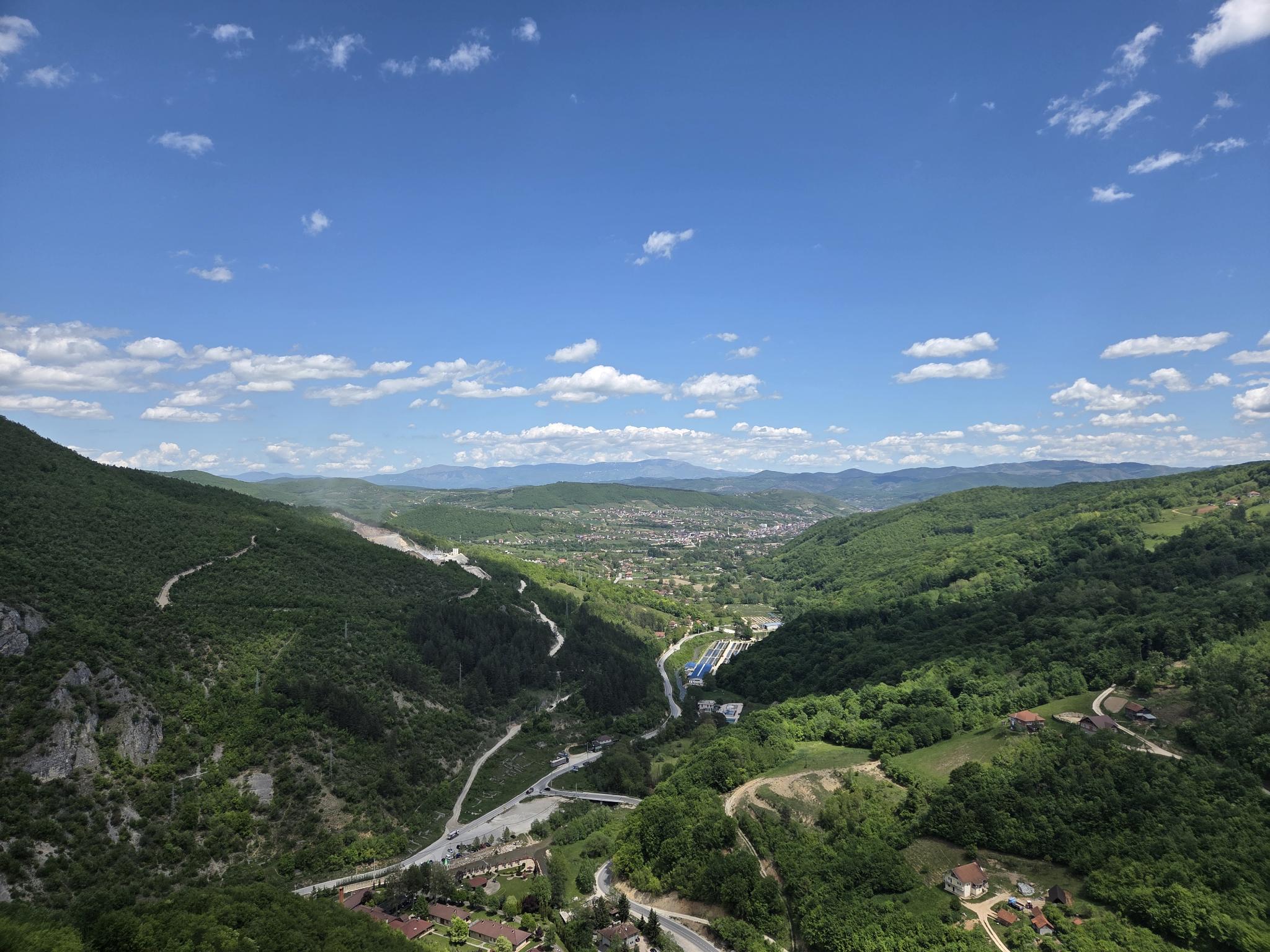
Welcome on the first ‘People’ series of my blog! In this series I will take you on a journey through the Sandžak of Novi Pažar, the little-known border region between Serbia and Montenegro. But don’t worry, it won’t be a boring history lesson, rather an array of impressions of this beautiful region with its shitty infrastructure and friendly people. Before we embark on this adventure though, let’s start with a little introduction.
When I told friends, family or colleagues that I was going to travel to the Sandžak of Novi Pazar, the reactions can be summarized as “What?” and “Where is that?” So I got the impression that the Sandžak of Novi Pazar, or short: the Sandžak, isn’t a particulary well-known region in the world, unless maybe you live there or have a special interest in Southeastern Europe. Assuming most of my readers are neither, I think it would be quite fitting to give some background information about this region and what makes it different than the rest of Serbia and Montenegro.
How it came to be …
In the 19th century the two countries to which the Sandžak nowadays belongs became independent from the (less and less) mighty Ottoman Empire. Serbia gained independence in 1815 and Montenegro in 1878. These two countries are actually quite similar: they share the same religion (Orthodox Christianity) and are both South Slavic states speaking (more or less) the same language. So you can imagine that the (also less and less) dominant Central European power, Austria-Hungary, wasn’t keen on this two countries merging into one big South Slavic state, supported by Russia. That would be a rather big threat to their southern border. Thus, also in 1878, when after one of many wars between the Ottoman and Russian empire the map of the Balkan was redrawn, Austria-Hungary took its chance and military occupied the Sandžak of Novi Pazar, in this way creating a buffer zone between Serbia and Montenegro.
But, what was this Sandžak? Well actually, the Sandžak as such never really existed. The word is derived from the Ottoman Turkish word sancak, meaning flag or banner, and was used to indicate an administrative division within the Ottoman empire. Thus in the 19th century there were around 150 of these sancaks (or districts), of which one was located around the city of Novi Pazar, a city in what is today southeastern Serbia, close to the border with Kosovo and only forty-something kilometers from Montenegro. The sancak of Novi Pazar was only created after an administrative reorganization in 1864, but still came to be the only sancak of which we speak today, but then in the Serbo-Croatian form of the word: the Sandžak.
The occupation of the region by Austria-Hungary had an unforeseen side-effect: the Muslim population in the Sandžak largely continued to live there, since the Austrian-Hungarians wanted to protect them as a counterweight against Orthodox influence. This wasn’t the case in the independent states of Serbia and Montenegro, where, as you can imagine, they weren’t big supporters of the religion of their former (in their words) suppressor. Austria-Hungary ended its occupation in 1908, but the Ottoman Empire could enjoy its regained rule only for a few more years, since after the Balkan Wars in 1912-1913 the Sandžak was lost definitively and was divided between Serbia and Montenegro. Still, the following decades, the Muslims could largely maintain their presence in the region, thus creating the main characteristic of the Sandžak: it is populated mainly by Muslims, in contrast to the other parts of Serbia and Montenegro.

Becoming Bosniak
Fast forward to the eighties and nineties: the communist state of Yugoslavia (which also had Serbia and Montenegro within its borders) is falling apart after the death of its leader Josip Broz Tito, the glue that held together the different nationalities of this multi-ethnic state. Nationalism is on the rise and erupts particularly violent in Bosnia and Herzegovina, where the Catholic Croats, Islamic Bosniaks and Orthodox Serbians start fighting each other. If you ask me, they aren’t that different: they speak variants of the same language (Serbo-Croatian or Bosnian/Croatian/Serbian/Montenegrin (BCSM) as it is called today), eat the same things and listen to the same type of music. But remember: these were very nationalistic times and hatred was omnipresent.
These events also had an effect on the Sandžak. Based on religious and historical reasons, the Muslims start to identify more and more as Bosniaks (who speak Bosnian), thus expressing a certain connection with the Bosniaks in Bosnia and Herzegovina. This also leads to a wish for political autonomy or even unification with Bosnia and Herzegovina. Political parties were formed, tensions between Serbians and Bosniaks grew and even a referendum was held but eventually nothing really came from it. Why? Because the Sandžak simply didn’t hold the right cards: it was an economically weak region, with a divided population (even within the Bosniak majority) and without forming one administrative unit (in contrast to Kosovo for example). Unification with the Bosniaks in Bosnia and Herzegovina furthermore seemed impossible since most Bosniaks in the region didn’t even live close to the border with Bosnia. So by the end of the nineties the different political parties that where striving to (different forms of) autonomy of the Sandžak were incorporated in the Serbian political system. Illustrative for the division is that on the Montenegrin side, there never really were Bosniak parties seeking autonomy. Eventually the region became divided again in 2006 after the independence of Montenegro from Serbia.

The situation today
The next posts will of course give you a more detailed insight in the actual situation of the Sandžak, so let me just focus on the key points here.
The Sandžak today is a region of around 9000 km² in southwestern Serbia and northeastern Montenegro, consisting of six Serbian and eight Montenegrin municipalities (although Andrijevica, Plav and Gusinje in Montenegro aren’t always seen as part of the region). The biggest city is Novi Pazar, which is – with around 70 000 inhabitants – the informal capital of the region. The region has approximately 350 000 inhabitants of which around 55% are Bosniaks, but mind you: not every Muslim is a Bosniak, there are also Albanian Muslims and Muslims who speak BCSM but don’t identify as Bosniak (but I won’t dive too deep in this here). The Bosniaks mainly live in the parts of the Sandžak bordering Albania and Kosovo, while Serbians and Montenegrins make up (most of) the remainder of the population.
Politically there exist several parties who represent the Sandžak and the Bosniaks. In Serbia we have for example the Stranka Demokratske Akcije Sandžaka (the Party of Democratic Action of Sandžak) and the Stranka Pravde i Pomirenja (the Justice and Reconciliation Party) and in Montenegro the Bošnjačka Stranka (Bosniak Party). Furthermore in both countries exist councils (a kind of representative bodies) that try to protect the cultural, linguistic and religious identity of the Bosniaks. But, like I said, all within the current borders: the wish for independence or unification with Bosnia seems to have faded away. Nowadays they rather call for some rather sort of self-governance or want to create a cross-border ‘Euroregion’, with close cooperation between the different parts of the Sandžak. Most striking to me though, was the sheer amount of offices these (and other) parties had, even in the smallest towns.
Last but not least, let’s talk economics: it’s bad. There is some industry: coal mines, a (military) truck manufacturer and a lot of textile industry (in Novi Pazar), but a lot of the factories I saw, seem to have been closed down after the breakup of Yugoslavia. Meanwhile you’ll regularly bump into a herd of sheeps or goats when driving around and it won’t be any problem to find onions, potatoes or homemade honey by the side of the road. These roads can be good, but also quite ‘patchworky’ and will never be highways. Furthermore, there are no international airports and only one (scenic) railway line runs from north to south through the region (as part of the Belgrade-Bar railway) . Poverty levels are high, as are unemployment levels (in some places around 60%). No wonder a lot of people (regardless of their ethnicity or religion) decide to emigrate to Western European countries as Germany or Sweden.
Sounds interesting to you? Join me now on my journey through the beautiful Sandžak!
Some sources
- Raymond Detrez. “De Sandžak.”In Donau (2011): 56-64. (In Dutch)
- Valeria Heuberger. “Der Sandschak von Novi Pazar.” In Österreichische Osthefte 47 (2005): 823-829. (In German)
- Wikipedia (I do apologize)
- MONSTAT. “Popis stanovništva, domaćinstava i stanova, 2023. godine.” (Census in Montenegro from 2023, in BCSM)
- Gordana Vojković. “Etnokulturalni portret Srbije.” 2025. (Ethnocultural Portrait of Serbia, in BCSM)
- MONSTAT. “Statistika dohotka i uslova života.” 2018. (Statistics on income and living conditions, in BCSM)
- “Primorje bez nezaposlenih, sjever na biroima: Drastične razlike u stopi nezaposlenosti po opštinama i regionima.” In Investitor (2025). (Article on unemployment in Montenegro, in BCSM)
- “Rang oblasti i opština prema stopi nezaposlenosti u 2023. godini.” In Makroekonomija.org (2025). (Overview of unemployment levels in Serbia, in BCSM)