
What happens when you ask a local in Prijepolje what’s interesting in his town? You’ll end up driving around in his car for an hour and a half, seeing not only the town, but also a canyon/film set and a medieval monastery, after which he pays for your lunch. I won’t say this necessarily will happen to you, but it happened to me during my first day in the Sandžak. Off to a good start…
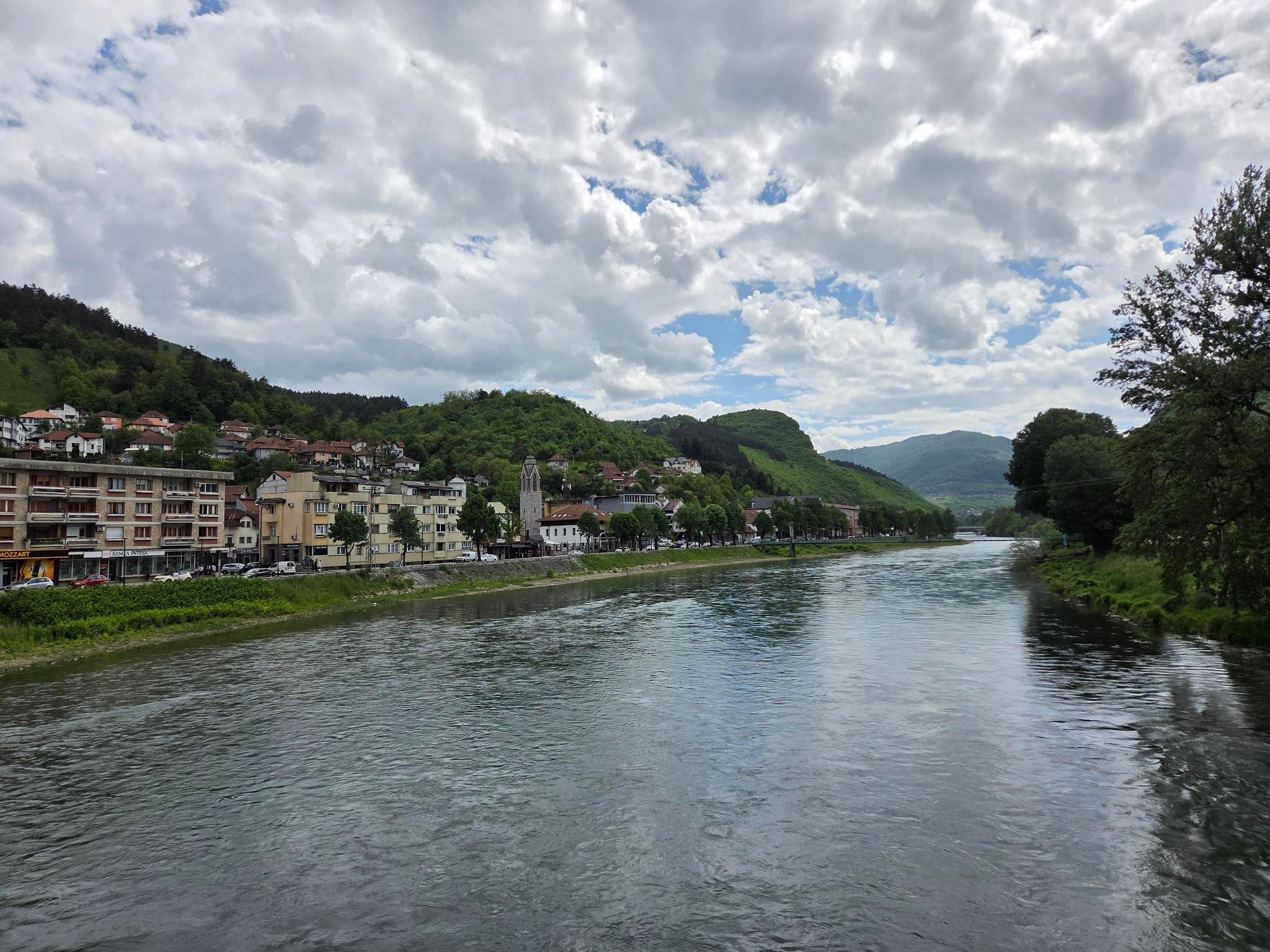
After a good night of sleep, I wake up in Prijepolje. The previous evening I arrived in this small town from Sarajevo, after a 3,5-hour drive in a small van . Prijepolje is located in the northern part of the Serbian Sandžak, close to the Montenegrin and Bosnian border (you can see my route through the region here). Its 30 000 inhabitants can enjoy the beautiful hilly surroundings as well as the confluence of the wild Lim and Mileševka rivers. I myself, an ignorant tourist, decide to ask the friendly owner of my apartment if he can give me some recommendations in Prijepolje. We end up talking and before I know it we jump in his car for a ‘quick’ tour around Prijepolje.

A monastery, a canyon and a film set
While driving, we talk about life, religion and Prijepolje. The owner (I prefer not to share his name here) talks about Prijepolje in the nineties. Back then there were around 50 000 inhabitants, but a lot of them emigrated, because of ethnic tensions and later on because of the bad economy. The Serbians, he says, had the feeling that everything belonged to them and so in Bosnia they did things like Srebrenica and other cruelties. He’s talking about the genocide in Srebrenica in 1995, where 8000 Bosniak men were killed by Bosnian Serb soldiers, an event that the Serbians until today don’t recognize as a genocide. He himself is a Bosniak and speaks passionately about his beliefs. The Christians, he tells me, say that Jesus is the son of God. But Jesus had a nationality, an ethnicity, so how can he be the son of God, if God is universal? It’s an interesting thought on which I can’t reply much, since my Bosnian vocabulary contains only a limited number of theological terms. Still, he has no problem at all showing me the monastery of Mileševa.
The monastery is located to the southeast of Prijepolje, along the Mileševka and dates from the 13the century. It features a church of which the lower parts are decorated with beautiful frescoes. The most famous one being the fresco from the White Angel (Beli Anđeo), showing an angel sitting on the tomb of Christ (unfortunately, taking pictures wasn’t allowed, so you’ll have to Google it). Beside the church there is a kind of guest house where pilgrims can stay, a shop, a picnic place at the bank of the river and of course a parking for all the buses with visitors. The monastery is quite popular, also because the relics of Saint Sava, probably the most important Serbian saint, were kept here up until the end of the 16th century. No wonder everything is well-maintained and in a very good shape.

We continue our trip and soon arrive in the canyon of the Mileševka, a beautiful canyon, where you can hear but not see (too much trees and bushes) the river flowing. The asphalt road changes into a gravel path and eventually we continue on foot, since there are too many rocks. The owner explains to me that in Yugoslavian times, they wanted to construct a road here that connects Prijepolje with Sjenica, a town 30 km to the southeast of Prijepolje. But, in Sjenica the population is almost exclusively Bosniak, while in Prijepolje only 40% of the people are Bosniaks. So the Serbians, wanting to avoid too much connection between the Muslims, obstructed the construction and the road was never finished. I’ couldn’t entirely confirm this story, but it’s a fact that along this path we find multiple tunnels that were clearly built for cars and not for hikers and squirrels. In one of these tunnels the famous Serbian movie Lepa sela lepo gore (Pretty Village, Pretty Flame, 1996) was filmed. It tells the story of a group of Bosnian Serb soldiers during the Bosnian War, trapped in a tunnel by Bosniaks. A popular, but not uncontroversial movie.

A mosque with a robot vacuum cleaner
We turn back to the city center and I ask him if he thinks that the road will ever be finished. He says it’s possible, but it depends from politics. Without Kosovo, he says, there are around 6 million people in Serbia, of which 2 million live in the capital. So where does all the money go? To the capital. And in Serbia, we have a lot of corruption: if you’re a member of the ruling party [the SNS, Srpska Napredna Stranka], everything is possible: even a baker or a taxi driver can become a minister, even if you’re incompetent. If I look around me, I can’t argue with him: the infrastructure is bad and looks old, certainly compared with Belgrade, where there are a lot of fancy building projects.
We arrive at the mosque, where the owner usually prays. It’s a small and simple mosque with some Ottoman tombstones in the yard. The inside is simple and of course without frescoes, but it does feature a robot vacuum cleaner, making sure the carpet stays clean all the time. I laugh at the sight: who says the Islam can’t be modern? We drive through the city center, past the market and the big mosque and a pattern becomes clear to me: the only buildings that are consequently in a good shape, are religious buildings. Private houses are often not entirely finished, with exposed brick walls, while government buildings look old and almost derelict. Maybe this says something about who has money in Serbia?

Our tour is almost finished but before we end I ask the owner if he wants the Sandžak to join Bosnia. He nods negatively: “there is no need to, nowadays we can do everything we want: speak Bosnian, go the mosque … The relations between Serbians and Bosniaks are okay, there are some tensions, but we can live peacefully.” Still, three of his children study in Sarajevo, rather than in Belgrade. Why? Because its’ a better environment, he says. Our tour ends and he stops close to a bakery where he orders a komplet with ćevapi for me: it consists of lepinja (flat bread) with scrambled eggs, kajmak (a kind of cheese) and ćevapi, the small sausages that are the pride of approximately everyone in the Balkan. I protest, but can’t avoid that he pays my lunch, after which he leaves me and goes back to work. Hospitality at its peak.
A Yugoslavian Dom Kulture and a shaky bridge
After lunch I wander around in Prijepolje and end up in the Dom Kulture, or Culture House. The name says it all: a theater/library/music school that was built in 1979 (back then called the House of Revolution). From the outside it looks run-down, but the inside is actually pretty nice (some financial support from Turkey may have helped with that). Two friendly ladies show me around. It has a great hall that can accommodate over a thousand visitors (a little much maybe, but remember, this was a way bigger town back then), and a small hall with 200 seats. Furthermore there is a library, music school and two galleries. One with quite modern local art and one that is currently closed but is dedicated to the local history. All in all, a pleasant surprise and my first Yugoslavian Dom Kulture.
I continue my walk and pass by the big Mahmut-Begova mosque and the Orthodox church, both nicely decorated, the first one with geometric patterns and a dark wooden interior, the second one with colourful frescoes. I decide to go to the other bank of the Lim, crossing the most shaky and rusty pedestrian bridge I have ever seen. The other bank is mainly a residential area, but it’s also where the railway station is located. As a train enthusiast I was eager to see it, but it turned out to be a bit of a disappointment: the station was in a bad shape, featuring tracks covered with weeds, an old railway building and a passenger tunnel with such an intense urine smell that I didn’t dare to enter it. My assumption about the infrastructure was once again confirmed. Still, a few trains a day stop at the station, being located on the line between Belgrade and Bar in Montenegro.


The fortress of Mileševac
Having some energy left, I decide to take a taxi to the fortress of Mileševac. A fortress that was built in the 14th century and is located on top of a cliff at the other side of the canyon from the Mileševka. I saw it on my trip to the tunnels in the morning and was intrigued by it. It’s located in a small village, Hisardžik, and was actually part of a medieval town (also called Mileševac), with the fortress located on top of the cliff and the lower town being where today Hisardžik is located. In the village there is a small mosque with a beautiful 400-years old handwritten Quran. But the mosque was closed, so no pictures here. I walk up the cliff along a path that changes between being clearly visible and non-existent. After a short but exhausting hike I arrive at the fortress: the views are stunning, but the fortress itself isn’t quite accessible and seems to consist mainly of crumbling walls (in contrary to what the information panel says). It has great tourist potential, but unfortunately, it doesn’t seem to get much care.


When I’m walking back from the fortress I once again pass by the monastery of Mileševa. There I observe a scene that seems to be illustrative for the infrastructure in the Sandžak: an old Lada with three police officers cramped inside passes by. A minute later, an Orthodox priest leaves in his brand new Škoda-SUV.
Leaving Prijepolje
Before ending this long post, I only want to describe two more things. The next day, when I was preparing to leave for Novi Pazar, I passed by the Orthodox church where there was quite a crowd. A lot of policemen were watching and even the fire brigade and an ambulance were present. What was happening? It was the slava of the church. This is the annual celebration and veneration of the patron saint of a family, monastery or church. A very important event for Serbians, for which – in this case – a procession was held. The procession featured a lot of Serbian flags (with or without coat of arms), including one of the longest flags I’ve ever seen, people in traditional clothing, a pick-up truck with a giant icon, a lot of clergy and lay people holding small icons. Quite impressive, if it where not for all the umbrellas (it was raining heavily) that made it all a little less … solemn?

While waiting for this procession to leave, I decide to quickly take a look at the small Roman-Catholic church, that was located at the other bank of the Lim. It was built during the Austrian-Hungarian time near the barracks of the (Catholic) soldiers. The information panel states that it “enjoys the protection and affection of all citizens of Prijepolje.” I’m willing to believe that, but it certainly does not get much protection and affection from the government …
